Monday, April 25, 2016

SB on Episode 6.1 (for 4/26/16)

SB on Episode 6.1 (for 4/26/16)
Answers and Questions
            In the first episode of the sixth season of Game of Thrones, a few questions that season five left unanswered were solved.  However, episode 6.1 also raised many new questions that may not be answered for some time. 


Answers
            One major mystery that was solved in episode 6.1 was the death of Jon Snow.  Yes, the opening shot of Jon Snow’s dead body and the coverage of the meetings in the first episode of the sixth season definitely confirmed that Jon Snow is dead and that this was not a dream (as some of the fan theorists have insisted). 
However, one of my classmates (House Seisser) introduced the possibility that the final episode of the series Game of Thrones may reveal that every episode of the series was a dream. House Seisser held that this may be Eddard Stark’s dream (or perhaps even a new character’s dream). 
This is worthy of consideration.  Even though connections between real world history and Game of Thrones can be made, it is impossible for me to deny that the entire Game of Thrones universe (and viewing experience) is quite dream-like. 
Another mystery that was solved in episode 6.1 was the survival of Sansa and Theon.  At the end of the tenth episode of the fifth season, Sansa and Theon jumped from the top of the castle, in order to escape Ramsay and the Reek lifestyle. Though this was not discussed in my previous blogs, I thought that it was possible that these two characters died or became seriously injured (and would eventually die) from the jump. 
I was happy to see the sibling duo alive and kicking.  Perhaps the best scene of episode 6.1 was when Sansa and Theon meet Brienne and Podrick.
Questions
            Even though this episode answered many questions that season five left unanswered, many new questions were raised in this episode.  Even though we saw Sansa and Theon escape, episode 6.1 left us with a new mystery about these characters:  what will become of this new connection between Brienne, Podrick, Sansa, and Theon? 
I look forward to seeing more coverage of this new group and their great escape.  Hopefully, this question will be answered in episodes of the near future.
            Even though episode 6.1 provided insight into the nature of Daenerys’s new situation that was introduced at the end of episode 5.10 (with the circle pit of horseback riding people), we are still not sure what will become of this situation.  We did learn that Daenerys’s status as the widow of Kal Drogo prevented her from having harsh treatment.  However, Daenerys’s other titles did not seem to have much significance here. 
There did not seem to be enough coverage of Daenerys in this episode to show the true nature of this new relationship between Daenerys and this new group.  I hope that there will be more coverage of Daenerys in episodes of the near future.
After discussing and reflecting on a few of these solved mysteries and new questions, I came up with a possible reason why this episode left me with such a sense of want for more information.  This is the first Game of Thrones blog that I wrote where the focus is on only one episode.
All of my previous blogs and viewing sessions of Game of Thrones revolved around three or four episodes.  This fact is worthy of mention because in only viewing one episode, you are left with less information than if you watched three or four episodes.  Obviously, this can provide one with a desire for more information.  It will be difficult to wait for one episode a week, but I am sure that all of these questions will be answered in time.

Monday, April 18, 2016

SB on 5.7, 5.8, 5.9, & 5.10 (for 4/26/16)

SB on Game of Thrones: Blog Entry Fourteen – Episodes 5.7, 5.8, 5.9, & 5.10 (For 4/26/16) 
New Connections in this Set of Episodes
            In this week’s set of assigned Game of Thrones episodes, many major characters formed new (and/or rekindled old) relationships with other major characters.  These new (and renewed) connections that were covered in this set of episodes might see further development in (and have a significant impact on the major plot points of) season six. 
            One old relationship that was rekindled in this set of episodes was the sibling relationship between Sansa and Theon (or “Reek,” if you prefer Theon’s new name).  The interactions between Sansa and Theon that took place in episodes 5.7 and 5.8 were particularly fascinating because these scenes depicted the initiation of a major change in Theon’s character. 
This change in Theon’s character could not be observed or confirmed by viewers until episode 5.9 when Theon threw Myranda from the castle (to her death) in order to escape with Sansa.  However, it is asserted that the scenes of dialogue between Sansa and Theon in episodes 5.7 and 5.8 showed Sansa helping Theon rediscover his true identity and remember his true name (namely, “Theon” rather than “Reek”). 
One new relationship that began and developed in this set of episodes was the political relationship between Danaerys and Tyrion.  The Targaryans and the Lannisters are historical enemies but, interestingly, Danaerys and Tyrion share certain political goals in common.  Also, even though Danaerys and Tyrion are quite different characters, these are two of my favorite characters.  The above listed facts made the scenes that covered this relationship to be particularly intriguing to me.  Even though Danaerys flew away on her dragon and left Tyrion in the coliseum in episode 5.9, I still predict (and hope) that Danaerys and Tyrion will interact in future episodes of Game of Thrones.   
Native American Indian History in Game of Thrones
            In addition to new interpersonal relationships, this week’s set of episodes also contained coverage of the development of new relationships between groups of people.  Consider the scenes in episode 5.8 that showed the negotiations where Jon Snow wanted to unite with the Wildlings in order to stand up to the White Walkers.
            It is clear that these negotiations (between Jon Snow and the Wildlings) have been happening in other recent episodes (that were not from this week’s assigned episodes).  It is also clear that other COMS 650 students have already made connections that are similar to the connection that I am about to make in some of their previous blogs. However, I made the observation that these scenes in episode 5.8 (that covered the negotiations) reminded me of certain characters and episodes from Native American Indian history.
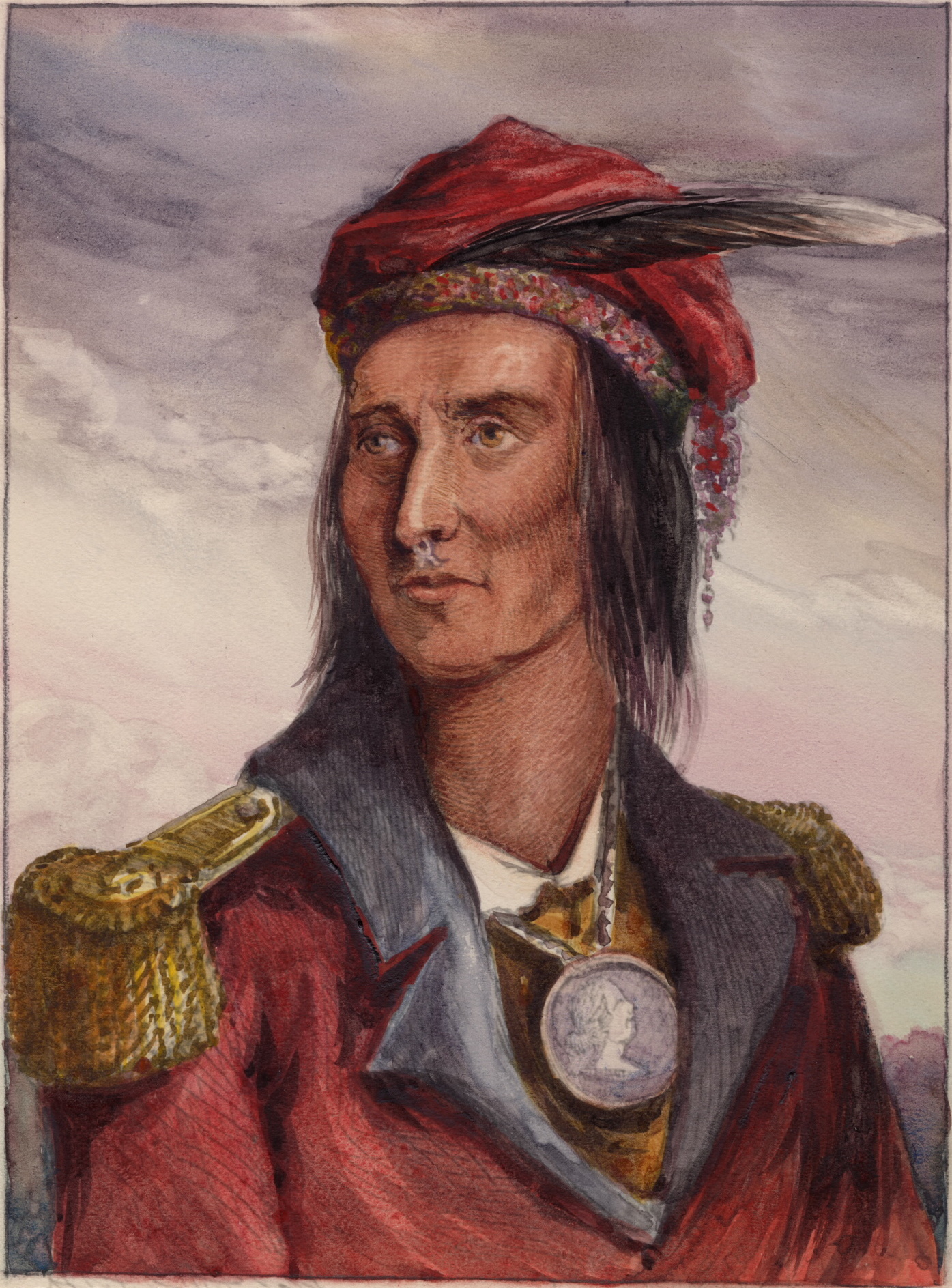
            As discussed by Jake Page in In the Hands of the Great Spirit:  The 20,000-Year History of American Indians, Tecumseh (a Shawnee) was one figure of historical significance who was dedicated to unifying various American Indian tribes in order to stand up to even greater hostile invasions.  These negotiations that took place in episode 5.8 shared commonalities with Tecumseh’s situation:  cultures that had previously fought with one another attempted to put aside their differences and unite in order to face a different kind of force that threatened the existence of their home and culture.
According to Jake Page, scholars have argued that some general regions of the contemporary United States have more American Indian culture than other areas because these areas (with more American Indian culture) are the areas where, historically, different American Indian tribes united and displayed the most resistance to hostile invasion.  As discussed in In the Hands of the Great Spirit:  The 20,000-Year History of American Indians, Tecumseh (a supporter of the unification of American Indian tribes) was killed in battle, but his vision of unification inspired others long after his death.
Jon Snow (a supporter of the unification of Game of Thrones tribes) was brutally killed by the Nights Watch at the end of episode 5.10.  However, viewers can still maintain hope that these groups might put aside their differences and unite in order to stand up to the invading White Walkers. 

Works Cited
Page, Jake. In the Hands of the Great Spirit:  The 20,000-Year History of American Indians.            New York, NY:  Free Press, 2004. Print.

Monday, April 11, 2016

SB on Episodes 5.3, 5.4, 5.5, & 5.6 (for 4/19/16)

SB on Game of Thrones: Blog Entry 13 - Episodes 5.3, 5.4, 5.5, & 5.6 (For 4/19/16) 
The “Way” of Thrones
            In this blog entry, it will be argued that this week’s set of assigned Game of Thrones episodes contained references to the philosophy of Taoism.  It will also be suggested that these episodes implied that Taoism is a good way to understand not only the Game of Thrones universe, but also the real universe. 
Taoism
The belief system of Taoism was first explicated by Chinese philosopher Lao Tsu in the Tao Te Ching.  As explained in the Tao Te Ching and as discussed by John Bowker in World Religions, “Tao” means “the way” and the belief system of Taoism involves “going with the flow” of the world, understanding the impermanence of life, and appreciating nature as a means to accept that many life events are beyond one’s control.  The Tao Te Ching is not a very long text, contains simple and understandable (yet extremely aesthetically appealing) language, and provides a deep, humble, and convincing theory of the meaning of human life.

Taoism in Game of Thrones
Just before Tyrion and Jorah were attacked by the stone men at the end of episode 5.5, they were riding down the river in their small boat while having a philosophical discussion and examining the Valyrian ruins.  Tyrion and Jorah discussed how the Valyrians were a great race of people who made significant contributions and that the Valyrians suddenly vanished and, in a way, were erased. 
Tyrion and Jorah’s talk about the Valyrians not only reflected Tyrion’s and Jorah’s personal concerns, but also revolved around the general theme of the impermanent nature of life.  Not only did Tyrion and Jorah’s discussion revolve around the Taoist idea of accepting change, but this discussion took place on a river and rivers are crucial symbols in Taoist philosophy. 
In the Tao Te Ching, life and the nature of existence, in general, were frequently compared to rivers.  To summarize, Lao Tsu declared that, like when dealing with a river, one should not fight the tide of life, but follow the natural order of things and go with the flow of the river of life.  As can be seen, Tyrion and Jorah’s discussion about the Valyrians seemed to be a brief explication of Taoism because this talk revolved around the (Taoist) theme of the changing nature of the world and took place on a river (which is an important symbol of Taoist philosophy).
In the Game of Thrones universe, where life tends to be quite brutal, it seems that Taoist philosophy might be a reliable and consistent way to approach an understanding of the nature of things.  With all of the major characters being killed and all of the increased violence and battles in recent episodes, it seems that a great way to make sense of the Game of Thrones universe is to accept the changing nature of this world. 
Clarification:  Argument for Taoism is Consistent with Arguments from Previous Blogs
In past blogs, I have asserted that Viking (and other forms of) mythology, rather than Taoism, might be the most reliable way to understand the Game of Thrones universe.  Even though Viking mythology and Taoism seem like opposites, I hold one can examine the Game of Thrones universe through the lenses of both Viking mythology and Taoism without running into inconsistencies.
I still believe that the Game of Thrones universe is heading for its own “Battle of Ragnarok” where, similarly to the universe of Viking mythology (that was explicated in Else Roesdahl’s The Vikings and Hazel Mary Martell et al.’s World Myths), the Game of Thrones universe (and all of the characters in it) will be destroyed.  However, I also believe that Taoism (as clarified by my investigation of Tyrion and Jorah’s discussion in episode 5.5) is a great way to make sense of the harsh nature of the Game of Thrones universe.  Further, it seems like Tyrion and Jorah’s discussion not only explicated that Taoism can be used to understand the Game of Thrones universe, but this scene might have also suggested that Taoism is a reliable way to understand the real world.

Works Cited
Bowker, John. World Religions. New York, NY: DK Publishing, Inc., 2006. Print.
Martell, Hazel Mary, et al. World Myths.  Florence, Italy: McRae Books, 2002. Print.
Roesdahl, Else. The Vikings. London, England: Penguin Books, 1998. Print.
Tsu, Lao. Tao Te Ching. Trans. Gia-Fu Feng & Jane English. New York, NY: Vintage                 Books,1997. Print.


Tuesday, April 5, 2016

SB on Episodes 4.9, 4.10, 5.1, & 5.2 (for 4/12/16)

SB on Game of Thrones: Blog Entry Twelve – Episodes 4.9, 4.10, 5.1, & 5.2 (For 4/12/16) 
Further Support for My “Ragnarok” Prediction from Last Week’s Blog
            In last week’s blog entry, it was explained how all of the characters from the universe of Viking mythology (and the universe of Viking mythology, itself) were destroyed in an epic, final battle that is known as “The Battle of Ragnarok” in Else Roesdahl’s The Vikings (and known as “The Twilight of the Gods” in Hazel Mary Martell et al.’s World Myths).  Last week, I predicted that since the television series Game of Thrones shares commonalities with the universe of Viking mythology, the television series Game of Thrones (in the final episode 7.10) will end with the destruction of all of the characters from the Game of Thrones universe (and with the destruction of the Game of Thrones universe, itself).
            This week’s set of episodes provided further support for my prediction that the series Game of Thrones will end with the destruction of the Game of Thrones universe.  As explained in World Myths and The Vikings, all of the diverse creatures from the universe of Viking mythology met in the battle of Ragnarok.  Similarly, there have been more diverse creatures interacting with each other, in this week’s set of episodes of Game of Thrones.   For instance, consider the major battle in episode 4.9 where there were giants riding wooly mammoths.  Also, consider how Daenerys’s dragons are getting so out of control that Daenerys had to chain the dragons in episode 4.10.
            As discussed by Roesdahl and Martell et al., all of the major heroes from Viking mythology (even those who had not yet met each other) met and destroyed each other in the epic battle of Ragnarok.  Similarly, some major Game of Thrones characters (who have not yet interacted with each other) have met and destroyed each other, in this week’s set of episodes.  For example, Arya and the Hound met Brienne and Podrick.  I thought that these two pairs would get along a lot better, but Brienne and the Hound battled to the death.  The Hound was left for dead by Brienne and Arya. 
            Deaths of Major Characters as Support for “Ragnarok” Prediction.  In this week’s set of episodes, some major Game of Thrones characters died.   While pointing an arrow at John Snow in episode 4.9, Ygritte was shot in the back and killed.  At the end of episode 4.10, Jaime freed Tyrion and, immediately after being freed, Tyrion murdered Shae and Tywin.  In episode 5.1, (referring back to the topic that was introduced in Matthew Tedesco’s article titled “It Would Be A Mercy: Choosing Life or Death in Westeros and Beyond the Narrow Sea”) John Snow “mercy killed” Mance Rayder in a very Last of the Mohicans-like fashion:  when Mance Rayder was about to be publicly burned, John Snow shot Mance Rayder with an arrow so that Mance Rayder would die a quick death and not suffer.  Also, there was a brutal public execution that happened before Daenerys at the end of episode 5.2 and is worthy of mention. 
Summation/Conclusion
            Similarly to “The Battle of Ragnarok” from Viking mythology, this week’s set of episodes of Game of Thrones showed many diverse creatures interacting with each other and showed many major characters dying brutal deaths.  These observations provide support for my assertion that (like the universe of Viking mythology) the Game of Thrones series will end with the destruction of the Game of Thrones universe (namely, with its own version of the “Battle of Ragnarok”). 
Further, I assert that this epic, final battle has already begun in recent Game of Thrones episodes:  more and more major characters (like Brienne and the Hound) who have not yet interacted with each other are beginning to interact with each other, mythological creatures (like dragons and giants riding wooly mammoths) are beginning to have a greater amount of presence, and major characters (like Ygritte, Shae, and Tywin) continue to die unexpectedly.   This week’s set of episodes (which included more giant creatures and more deaths of major characters) provided support for my assertions that (a) Game of Thrones and Viking mythology share commonalities and that (b) the series will end with the destruction of the Game of Thrones universe.

Works Cited
Martell, Hazel Mary, et al. World Myths.  Florence, Italy: McRae Books, 2002. Print.
Roesdahl, Else. The Vikings. London, England: Penguin Books, 1998. Print.
Tedesco, Matthew.  “It Would Be A Mercy: Choosing Life or Death in Westeros and Beyond       the Narrow Sea.”  Game of Thrones and Philosophy:  Logic Cuts Deeper Than Swords.        Eds.   William Irwin and Henry Jacoby. Hoboken, NJ: Wiley & Sons, Inc., 2012. 99-112.        Print.

Saturday, March 26, 2016

SB on Episodes 4.5, 4.6, 4.7, & 4.8 (for 4/5/16)

SB on Game of Thrones: Blog Entry Eleven
Increase in the Amount of Coverage of Daenerys
            While viewing this set of episodes, I noticed an increase in the amount of coverage of Daenerys.  Not only is Daenerys gaining more power, but Daenerys’s connections to other major Game of Thrones characters (who Daenerys has not yet directly interacted with) are becoming more apparent.  For example, when Cersei, Varys, Tywin, and others were having a discussion in episode 4.6, they spent a significant amount of time talking about Daenerys and how Daenerys is becoming a major threat with her three dragons.
            Even though these characters are all major Game of Thrones characters, some of these characters (like Cersei and Daenerys) have done a fairly little amount of direct interaction with each other, at this point in the series.  However, recent episodes have shown a great deal of progress of the storyline of Daenerys.  I am excited to see how the meeting of these major characters plays out and I am excited to see how this complex game for the throne will end.
Connections between Game of Thrones and Viking Mythology
            It will now be argued that the television series Game of Thrones resembles Viking mythology. As discussed by Martell et al. in World Myths and by Else Roesdahl in The Vikings, the Vikings (like other cultures) had their own system of mythology, which was made up of stories about specific heroes (including Thor, Loki, and others), and reflected the values of their culture. 
As explained in World Myths and The Vikings, every single character and creature (gods and demons, alike) from the stories of Viking mythology met in an epic, final battle called “The Battle of Ragnarok.”  The legend of “Battle of Ragnarok” (titled “The Twilight of the Gods” in Martell et al.’s World Myths) explained the details and the outcome of this fierce, mythological battle:  every single god and creature from the mythological world was killed in this final battle and, from the ashes of this battle, the natural world formed, created itself, and created the human race.
Viking legends each told their own story, but the fate of all of the characters from these stories (and the fate the entire universe of Viking mythology) was determined by one final battle.  All of the individual legends that make up the body of Viking mythology, can be thought of as individual episodes that make up the entirety of a television series. 
Like Viking mythology, Game of Thrones tells stories about specific heroes, villains, and creatures, and all of these characters are interconnected by the major problem of their universe:   the battle for the throne. Like the universe of Viking mythology, the fate of the universe of Game of Thrones will be determined by the outcome a final battle.
Based on the outcome of the universe of Viking mythology (the destruction of this universe at the Battle of Ragnarok), I will make a prediction about the final outcome of the Game of Thrones universe. I do not want to make an invalid analogy fallacy.  It is understood that just because Game of Thrones and Viking mythology are alike in some ways does not mean that they are alike in every way.  However, I predict that (similarly to how the Battle of Ragnarok resulted with the destruction of the universe of Viking mythology) the final battle for the throne (in episode 7.10) will result with the destruction of the Game of Thrones universe.
I am not only basing this prediction (of the destruction of the Game of Thrones universe in the final episode) on the similarities between Game of Thrones and Viking mythology.  It seems like, with winter coming and with Daenerys slowly approaching with her growing dragons, Game of Thrones takes place in an apocalyptic time period.  To me, it looks like the Game of Thrones universe is heading for a “Battle of Ragnarok” of its own.

Works Cited
Martell, Hazel Mary, et al. World Myths.  Florence, Italy: McRae Books, 2002. Print.
Roesdahl, Else. The Vikings. London, England: Penguin Books, 1998. Print.


Friday, March 25, 2016

SB on Episodes 4.1, 4.2, 4.3, & 4.4 (for 3/29/16)

SB on Game of Thrones: Blog Entry Number Ten 
The Death of Joffrey
            Even after Joffrey survived the first three seasons, I still knew Joffrey would get what was coming to him.  When Joffrey finally died in episode 4.2, however, I had mixed feelings about it. 
Even though Joffrey died a gruesome death, I still feel that (when compared to some of the other dead Game of Thrones characters) Joffrey died a relatively quick and easy death.  Yes, the choking and the foaming made it seem like a terrible way to go, however, Joffrey died at his wedding party, died with his mother next to him, and died before he ever recognized (and apologized for) his errors. 
I am not wishing that Joffrey died a more painful death.  I am glad that the death of Joffrey did not involve torture or (too much) extreme gore. But after considering all of the harm that Joffrey committed against so many people (including the public humiliation of Tyrion in this same scene), it seems that Joffrey had a relatively quick and peaceful exit. 
I was hoping that Joffrey would have the capacity to understand the errors of his ways and to maybe even genuinely apologize (to Sansa, Tyrion, or anyone) for how evil he was.  Joffrey never really did this and I was hoping that he would before he died.
Connection to other Media.  Some might consider this to be a stretch, but Joffrey’s death almost reminded me of Vito Corleone’s death in The Godfather.  In sum, after a life of committing and organizing gruesome crimes, Vito died of a heart attack in his garden.  Many viewers of The Godfather have held that Vito had a relatively peaceful death because Vito did not die in a shootout or a gory scene, but died next to his grandson while gardening.
When I first saw The Godfather, I was upset and felt that, considering all of the crime that Vito was involved with throughout his life, Vito had a relatively peaceful exit.  However, I feel differently about (and have a greater appreciation for) Vito’s death after a few re-watches of The Godfather (and the sequels).  Perhaps, my mixed feelings about Joffrey’s death will change when I re-watch Game of Thrones, one day.
The Impact of Aristotle’s Ethics on Medieval Philosophy Depicted in Game of Thrones
            In episode 4.3 when Tywin, Cersei, and Tommen were observing Joffrey’s body, Tywin was trying to teach Tommen about what it takes to be a king and gave specific examples of previous kings and their errors.  Tywin explained how one king was so pious that he wouldn’t eat anything (because this king believed that food was an earthly, sinful pleasure) and, as a result, died of starvation.  Tywin also told the story of a gluttonous king who died from over-indulging in earthly, sinful pleasures.  Tommen asserted and Tywin confirmed that a good king must have wisdom to avoid extremes.
            This scene reminded me of Aristotle’s ethical principle of the golden mean, which is discussed in (Robert C. Bartlett and Susan D. Collins’s) Aristotle’s Nicomachean Ethics and other works of Aristotle.  In sum, the golden mean principle is the idea that one should avoid extremes.  For example, (going off of Tywin’s comparison of the kings) eating too much and eating too little are both harmful because one must eat a healthy (middle) amount, in order to survive. 
            Samuel Enoch Stumpf and James Fieser (in Philosophy: History and Problems) and Frederick C. Copleston (in Medieval Philosophy) explained how Aristotle’s works had a great influence on medieval philosophy.  Not only were Aristotle’s views on ethics highly regarded in medieval philosophy, but so were Aristotle’s views on logic and other topics (as discussed in Copleston's Medieval Philosophy and Stumpf & Fieser's Philosophy: History and Problems). 
No explicit reference to Aristotle was made in this scene.  However, knowing that Aristotle had such a strong influence on medieval philosophy and knowing that this is one time period that is explored in Game of Thrones, I made the connection and observed that Tywin was teaching Tommen the lesson of Aristotle’s golden mean.  As can be seen, Aristotle’s influence on medieval philosophy was depicted in Game of Thrones.


Works Cited
Bartlett, Robert C. & Collins, Susan D. Aristotle’s Nicomachean Ethics. Chicago, IL: The University of Chicago Press, 2011. Print.
Copleston, Frederick C. Medieval Philosophy. New York, NY: Harper Torchbooks, 1961. Print.
The Godfather. Dir. Francis Ford Coppola. Perf. Marlon Brando, Al Pacino, James Caan, and Diane Keaton. Paramount Pictures, 1972. Film.
Stumpf, Samuel Enoch & Fieser, James. Philosophy: History and Problems. New York, NY: McGraw-Hill. 2008. Print.


Tuesday, March 15, 2016

SB on Episodes 3.7, 3.8, 3.9, & 3.10 (For 3/22/16)

SB on Game of Thrones: Blog Entry Number Nine
Perceptions of Trust 
            In this set of episodes, two different viewpoints towards human kindness were explored. One of these perspectives was explicated (in episode 3.9) when the Hound Dog told Arya that, one day, she will be killed because she is too kind.  Later on in this same episode, a different perspective was endorsed when Daario told another character that people who have suspicious minds are usually deceptive people, themselves. 
These are two different ideas about the connections between trust, honesty, kindness, well-being, and functionality that were presented in this set of Game of Thrones episodes.  I will not make a judgment about these two perspectives based on the characteristics or the actions of the characters who stated them. I will not make a judgment about these two perspectives based on an analysis of any single character.  However, it seems safe to declare that the Hound Dog is correct in this debate and a fair degree of skepticism, or (as put by Daario) “suspicion,” is not only desirable, but is required in order to survive the Game of Thrones.
     For example, consider the Red Wedding scene at the end of episode 3.9 where a number of major characters (like Catelyn and Robb) had their guards down, were betrayed, and were brutally murdered.  Another instance of an act of violence that was, arguably, caused by characters being “too trustworthy” of each other from this set of episodes was when Ygritte shot Jon in episode 3.10.
Throughout the series, many characters have unexpectedly betrayed and/or taken advantage of the kindness of other characters.  As mentioned by Anglberger and Hieke in “Lord Eddard Stark, Queen Cersei Lannister: Moral Judgments from Different Perspectives,”   the series seems to communicate that even virtuous characters (like Eddard Stark) can have unfortunate fates. 
It seems that being too kind to others in the Game of Thrones universe, as suggested by the Hound Dog, can result in one’s death.  It seems quite clear that one must have his or her guard up in order to even have a mere chance at survival in the Game of Thrones.  This is why I endorse the Hound Dog’s “suspicious mind” (insert Elvis song) position, rather than Daario’s position.
Gilly and Samwell’s Journey
            I really enjoy the scenes that cover the adventures of Gilly, her baby, and Samwell.  The development of Samwell’s character was fascinating.  I was not expecting Samwell to destroy the White Walker that was approaching Gilly, her baby, and Samwell’s cabin in episode 3.9.  The development of Gilly and Samwell’s relationship is interesting.  Gilly suggesting “Sam” as a name for the baby was not expected.  I am excited to see what happens with Gilly and Samwell’s relationship.
Comedy in Game of Thrones.  It must be mentioned that Samwell’s comic relief was really appreciated in this particularly dramatic set of episodes (which included the “Red Wedding,” sexual torture, and the deaths of major characters).  Even though many of Samwell’s characteristics, including his sense of humor, may seem quite “modern” or “contemporary,” I really appreciated his wit in these episodes.  For instance, I thought the interaction where Gilly referred to Samwell as a “wizard” was funny and I found humor in (the delivery of) some of Samwell’s baby name suggestions.  
Importance of Music and Lack of Music in Episode 3.9
            In the final moments of episode 3.9, music played an important role in communicating the drama of this episode.  Before the famous Red Wedding scene began, the wedding band’s slower instrumental folk song served as a kind of signal to begin the gory and intense attack where a number of major characters (including Catelyn and Robb) were killed.  Further, immediately after the brutal murder of Catelyn, this dramatic scene (and this episode) ended and the credits rolled without any music.  It is unusual when there is no music to accompany the ending credits of episodes of Game of Thrones.
This concluding massacre scene contained music and sounds of many kinds (with screams and sounds of violence) that added to the intensity and drama of the scene.  However, the lack of sound and complete silence that came after was such a sudden contrast to this particularly loud concluding scene. This contrast made the conclusion of the episode even more dramatic.

Works Cited
Anglberger, Albert F. F. & Hieke, Alexander. “Lord Eddard Stark, Queen Cersei Lannister:         Moral Judgments from Different Perspectives.” Game of Thrones and Philosophy:Logic        Cuts Deeper Than Swords. Eds. William Irwin and Henry Jacoby. Hoboken, NJ: Wiley &        Sons, Inc., 2012. 87-98. Print.